


Conquering the Grand Canyon with My Uncle in My Heart

by Jenna Hensel

In the Grand Canyon, the warm, multi-colored, rocky canyon walls loomed above me with a terrifying and enticing presence. I was an ant, one of over a billion tiny parts of the magnificent canyon. Really, I was a guest. I embarked on an REI Level Five (the most advanced level) all-women backpacking trip, descending and ascending the South Rim of the Grand Canyon with my guides and the other participants. I wanted to take on this level of backpacking because I wanted to challenge my mind and body in ways that they had not been challenged before.
Most of my hiking experience consisted of hiking the Wisconsin trails and bluffs. I lived in Wisconsin for most of my twenty-seven years. In the past, I also hiked Mount Rainier in Washington, the Great Smoky Mountains in Tennessee, and between the Rocky Mountains in Colorado. However, my backpacking journey started a year before, when I backpacked twenty-eight miles of the Pacific Crest Trail. This Grand Canyon backpacking trip was the next big adventure.
On this trip, we were going to be in the arduous heat for four days and three nights. Our grand total would be backpacking 25 miles over desert terrain that was steep, rocky, and constantly changing underneath our hiking shoes.
Before the trip, I experienced one of the worst two-week periods of my life. It began with my five-year relationship ending, and me moving out of my former partner’s house and into my parents’ house. My 93-year-old grandma went into assisted living. I had a terrible sinus infection that worsened with each day. At its peak, I had a fever of 102 degrees. Lastly, ten days after I moved back home, my Uncle Jeff died by suicide.
I almost didn’t go on this trip, which I booked over one year ago, and trained all summer for. I recovered from my sinus infection a few days before the trip; physically, I was fine. Mentally, I was not. My uncle passed seven days before my trip, and I was adamant that I did not want to miss the funeral. We weren’t hearing when the service would be, and I was terrified I wouldn’t be there. My parents reminded me that, similar to myself, Uncle Jeff was adventurous. He traveled and went skiing every year in the Rocky Mountains. He was also an avid bike rider and went paragliding. My mom reminded me that he would want me to go, and there were other ways I could honor him if I could not make the service. She also said that when I finished, I should give him a high five, because he would be so proud that I completed it. Even though part of me was reluctant to leave, I knew my parents were right, and I agreed to go on my trip. I prayed that I would still be able to attend the service.
Our excursion began with orientation in front of the General Store on the South Rim of the Grand Canyon. We started with introductions; five of us were participants, and our two guides were mother and daughter. Other than our guide, who was in her early twenties, I was the youngest. The other women’s ages ranged from their thirties to mid-sixties. During the orientation, our guides went over a few housekeeping items. First, tents were optional. We could bring our tent, or we could set up our sleeping pad and sleeping bag in the open and sleep under the stars. The guides said that they never had a problem with critters while sleeping under the stars. I immediately knew I would not bring my tent; I couldn’t pass up what would likely be my only opportunity to sleep under the stars! We had to be extremely strict about what we carried in our packs, due to the high level of difficulty of the trip. Every ounce added up to pounds we carried on our backs. Our guides said that deodorant was not allowed because it could pollute the waters. Lastly, we had to keep up our electrolytes through tablets, drink packets in our water bottles, or both every day. Keeping up electrolytes is vital when performing rigorous exercise in the heat because sweating causes fluid loss, including electrolytes, which can cause dehydration and exhaustion. In short, a lack of electrolytes has the potential to derail your hike by weakening your body. I never heard this before, but it made sense. I took a plentiful amount of drink packets and tablets to fuel myself.

We were also responsible for packing our own snacks and lunches. I had tortillas packed for lunch and a plethora of nuts, crackers, banana chips, cookies, and protein bars for snacks. For backpacking, the best food is lightweight, high-calorie food that is high in salt and carbohydrates to give you energy and keep up your electrolytes.
After performing a gear check, we loaded the trail buses and rode to the Hermit Trailhead. From there, we began our descent. Day one of our hike was purely downhill. We descended 3,750 feet in an elevation of over 8.2 miles to Hermit Creek, which took eight hours. Although we left the trailhead where people mingled around us, we lost the small crowd as we descended. For the rest of the day, we did not see anyone. It was eighty degrees, and the sun shone high in the clear blue sky.
I was shocked at how steep, uneven, and rocky the descent was. The loose rock constantly shifted below my feet, and every footstep had to be meticulously placed so that we did not tumble forward. I aimed for the large, flat rocks to get the most stable footing. Even with my effort to execute each footstep with utmost precision, I still slipped and slid my way down and fell twice. I never encountered this kind of terrain on any hike I did before, and this terrain didn’t exist anywhere in Wisconsin. Gradually, my ankles began to protest, and I felt twinges of pain that worsened as the day went on.
We climbed over some large boulders almost as tall as me with our packs; every hand and foot placement counted so as not to hurt ourselves falling on the sharp edges of the rock. We also passed some plants where we heard rattling. Likely, these rattles were emitted from rattlesnakes, warning us to go away. We listened!
Slowly, I fell farther behind the group because of my ankle pain. Towards the end, I lost sight of the group, but I pushed through the pain and gritted my teeth during the painful jolts. One of the guides followed closely behind me. When we caught up with the other women at the campsite, I broke down crying because my ankles were searing from constant twisting. I took ibuprofen, which I never did for a hike, and I rested. Filled with frustration, I questioned if I had made the right choice to complete this trip.
That night, lying under the stars, I wondered if Uncle Jeff would be proud of me. Was I as strong as I thought I was? Had all my preparation in Wisconsin been for nothing? Regardless, the inky sky was a warm, calming blanket, and the stars shone clear as crystal. I fell asleep, feeling a mixture of awe and disappointment.
When I woke up the next day, the pain had subsided. I mentally picked myself up and reminded myself that I was strong, and I could do this hike, one step at a time. I didn’t tell the other women about what happened during the two weeks before my trip. It was too fresh to discuss with people I had just met, and I didn’t want to fall into a deep sadness while I was on a backpacking trip that had been on my bucket list for over a year.
It was a new day and a new beginning. We had another gorgeous, sunny, eighty-degree day ahead. I popped another ibuprofen and continued to take it throughout the trip to help lessen the pain. One of the guides said that the only way to get “canyon legs” is to hike in the Grand Canyon, which boosted my confidence. The rest of the trip was progressively easier on my ankles as I acclimated to navigating the unstable canyon rock. She was right.
On our second day, we descended further into the canyon to the Colorado River, hiking 5.1 miles at a decrease of 570 feet in elevation. Although we still encountered the loose rock, the elevation loss was much less intense.
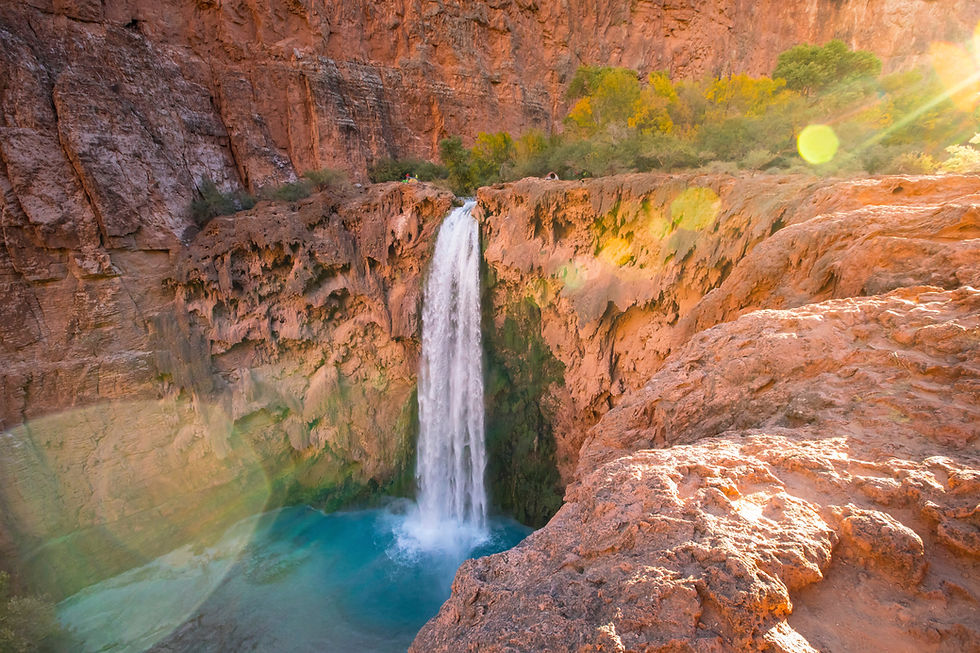
We stopped at a few waterfalls that we were able to swim in. This was as close to a shower as we were going to get. The water was freezing, and we were soaked from head to toe. The pounding water from the waterfall seemed to wash away all of the dirt and grime that had accumulated on me. Later, on a break, we saw a big-horned sheep in the distance. This was our first major sign of wildlife.
Our hike for the day ended when we reached the roaring Colorado River. We socialized and explored along the river for the remainder of the day. As enticing as the water looked, we could not swim in it. Otherwise, we would be swept away by the rapids. The Colorado River is rated as an intense level five for whitewater rafting. We had delicious tortellini for dinner and slept on land adjacent to the Colorado River, under the stars again. Surrounded in pitch darkness with only the glow of the silver stars for illumination, and the sound of the Colorado River rapids running, I never stayed anywhere so beautiful. I felt more confident in myself.
On day three, we hiked to Monument Creek, ascending 1.6 miles at an elevation of 670 feet. This was our rest day, before we hiked back to the rim the next day. The day was again eighty degrees and sunny. We stopped at a rocky passage for a rock scrambling break. During our extended break before the scramble, bats flew over us, dipping low enough that we shuddered as they flew over our heads. After our break, we left our packs at the base of the scramble passage and climbed up and over large rocks to reach a destination that our guides promised had spectacular views. It was rigorous, and again, every hand and foot placement counted to avoid a painful fall.
Halfway into our scramble, two large slabs of rock rose on the left and right sides of us, with water running down between them. Due to the slippery nature of the rocks between the two large slabs, we had two options: (1) walk upward vertically very carefully between the rocks so as not to slip and fall; or, (2) ascend the passage horizontally with hands on one of the slabs of rock, feet on the other, and climbing hand to foot up the rocks. Naturally, as my main purpose for this trip was to challenge myself in the greatest way possible, I went with option two.
I put my hands on the right slab of rock and pushed as I lifted my feet onto the left slab of rock, and in line with my hands. I was horizontal at an upward angle to the ground. I moved up between the rocks, moving my left foot and right hand, followed
by my right foot and left hand. I pressed my hands hard into the rock as I moved, and engaged my core to keep myself stable and to prevent slipping. Even though the running water between the rocks made the path especially slippery, some water splashed up on the slabs of rocks we were climbing, and we had to move at a slow, steady pace so we would not slip in an instant and fall onto the sharp rocks in between the rock slabs. Upon reaching the top, I stepped down and stood up. The women who had already climbed cheered for me for successfully passing through, and I cheered on the other women behind me as they climbed to join us at the top of the passage. Everyone successfully completed the scramble.
After some more climbing, we reached the top of the passage, where we took in a small, yet beautiful waterfall. Rivers of canyon led up to more layers of warm color, and the clear clouds that looked as full as pillows hung overhead. Even in the small hidden treasure areas of the canyon, it seemed to never end.
After scrambling down and sliding on our butts over the especially slippery rock, we gathered our packs and hiked to our last campsite, Monument Creek. We were 3,650 feet in elevation below the canyon rim. At this campsite, we saw scorpions hustle away as our footsteps neared them. Our guides surprised us with burritos, popcorn and small, portable face masks that we could apply to our drenched faces. The face mask was cooling and felt like heaven against my face. I felt slightly clean. I always missed showers when I was in the backcountry.
Our last day was going to be the most rigorous. We had been preparing for it for the past three days. After backpacking for three days and three nights, we would ascend to the top of the canyon. It was time to leave the canyon and its glory behind. The next day, we were going to hike to the rim for 9.3 miles, transcending 3,650 feet in elevation.
We began the last day by waking up at 3:00 AM in pitch darkness so that we could beat the heat for the majority of the hike. We stuffed our sleeping bags into stuff sacks and packed our belongings in our packs with only our headlamps for light. One of the women, Denise, said, “Look, it’s a mouse!” and her headlamp swung across it. The light illuminated the small brown mouse in the center of our campsite. I let out a small squeal, covered my eyes, and hunched forward. No animals scared me as much as rodents did (not even scorpions); I could barely look at mice. I filled up my water bottle and put an electrolyte pack in it. After we assembled our backpacks, we began hiking down the small hill from our campsite with only the light of our headlamps to guide us down the steep, uneven, rocky terrain.
About an hour later, we stopped to have breakfast. Daylight was starting to break, and there was a gray, clear morning light. Breakfast was dried fruit and oatmeal. I can’t stomach oatmeal because of the look and texture, so I ate the dried fruit. I felt the food fuel my body for the additional miles and elevation gain ahead.
After breakfast, we began climbing out of the canyon. We put our headlamps away because the morning light was enough to guide us up through the rocky brown terrain. Our trekking poles were instrumental in helping us propel our bodies upward against the steep climb that we were conquering.
By midafternoon, the sun was higher in the sky and the sunlight was bright. I could feel the sweat building on my body. We stopped under a rocky overpass to have lunch. I had a tortilla with cheese and a protein bar.
We continued to hike and stopped under a second rocky overpass to fill up our water bottles at a water source, and dip our shirts in water so that our wet shirts would help cool our skin for the remainder of our climb. I was now full-on sweating. The sun was at its highest in the sky, the terrain was at its steepest, and therefore, we were in the most challenging part of our hike.
We climbed the last quarter mile of our hike with the sun beating down. Our guides introduced fun distractions for us as we climbed. We played a game called the Animal Game, where we went down the line, yelling out alphabetical animal names that corresponded with the alphabetical letter called out (for example, aardvark for the letter A). These games helped take our minds off the strong heat and, therefore increase our resolve.
When we reached the rim of the canyon, I pumped my fist with my trekking pole looped around it into the air and high-fived Uncle Jeff. I felt a surge of emotion, and I knew that he would be happy. The other women and I were exhausted, overjoyed, and proud. We celebrated with lots of pictures, hugging, and congratulating. As a group of empowered, strong women, we succeeded in completing our advanced backpacking trip, and left the canyon with newfound friendships, timeless memories and stories to share. As we rode the bus from the Hermit Trailhead to the parking lot, text messages bubbled onto my phone screen, now that my phone had service again. A text from my mom popped up. My uncle’s funeral was scheduled for the following week; I would be able to attend the service. I closed my eyes and prayed thanks that I hadn’t missed it.
I successfully completed a backpacking trip of the highest rigor with REI; I met my goal. Physically, I proved to myself that I had the strength and endurance to navigate the difficult, rocky, uneven terrain of the canyon. Mentally, I proved to myself that I had the perseverance and optimism to succeed at any task I chose to take on. Everything is simple when backpacking. There are no distractions or drama, except those that you create for yourself with your thinking. You are literally carrying your materials to survive on your back. In a sense, you are on your own, which is a test of agency. Your intrinsic motivation is what will make or break you. I learned that I can do anything. I am the author of my own story. Uncle Jeff would be proud.
***

Jenna Hensel is the author of the Note, “How a New Standard of Care Can Make Social Media Companies Better ‘Good Samaritans,’” which is published in Volume 105 of the Minnesota Law Review. This is her first memoir. She holds a BA in psychology from the University of Wisconsin-Madison and a JD from the University of Minnesota Law School. In her free time, Jenna enjoys hiking, backpacking, exercising, spending time with her family, and reading.


Comments